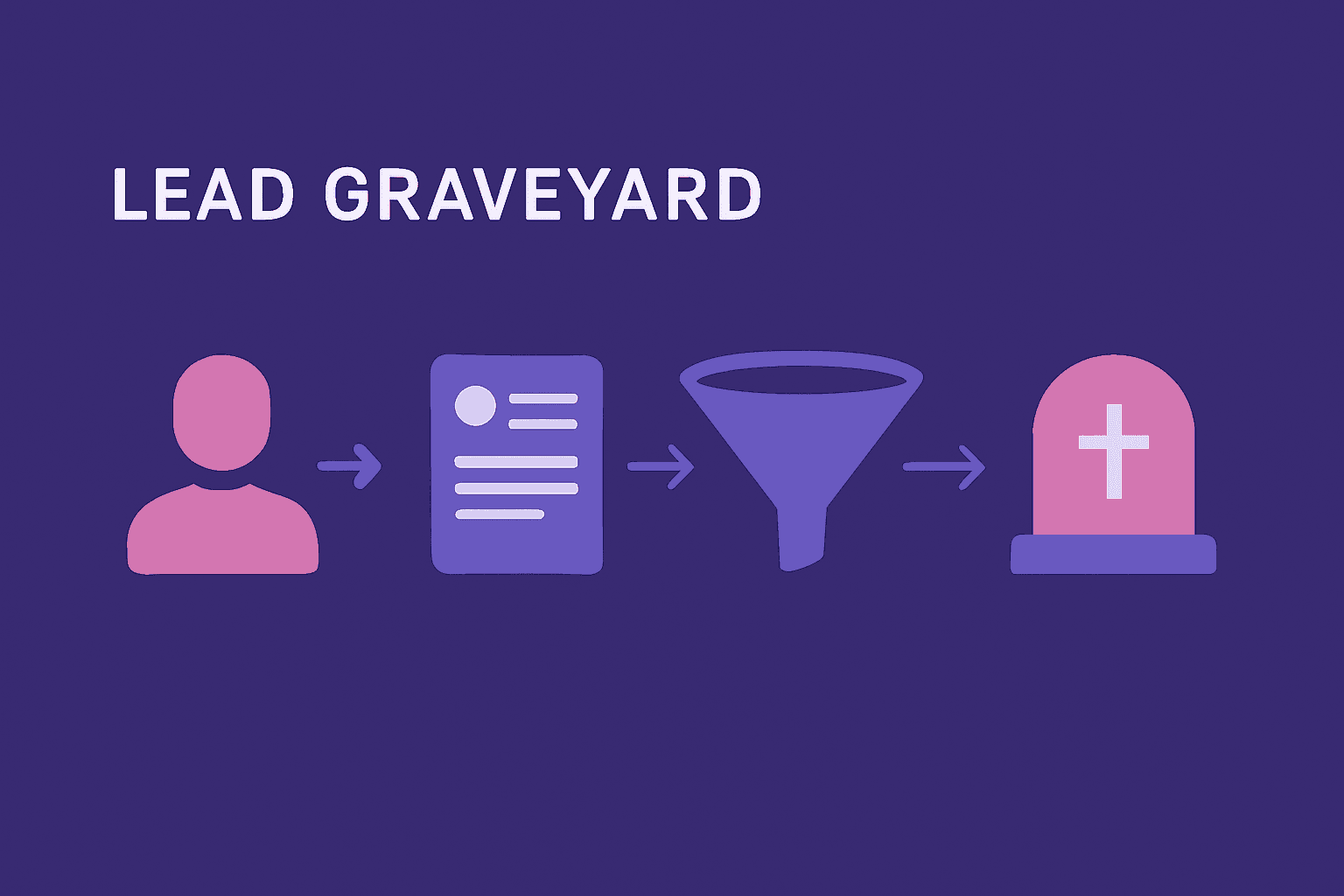
Why 70% of Your Leads Are Dying in Your Pipeline (And the Scientific Formula to Fix It)
You're hemorrhaging money, and you don't even know it.
Last month, 200 qualified leads entered your pipeline. You closed 15 deals.
That's a 7.5% conversion rate. Congratulations - you're slightly below average.
But here's what keeps me up at night: What happened to the other 185 people who raised their hands and said "I'm interested"?
They didn't suddenly stop needing your solution. They didn't all choose competitors. They didn't die.
They just... faded away. Into the lead graveyard where good intentions go to die.
And the worst part? You probably think this is normal.
It's not. And I'm going to show you exactly why those leads are dying - and more importantly, how to resurrect your pipeline before you lose another month's revenue.
The Lead Decay Curve: How Fast Money Evaporates
Let's start with some uncomfortable math.
Minute 1: Lead fills out your contact form. Interest level: 10/10. They're thinking about your solution right now.
Hour 1: No response yet. They've checked their email twice. Interest level: 8/10. They're still warm, but opened a competitor's tab "just to compare."
Day 1: Your sales rep sends a "Thanks for your interest!" email. Interest level: 5/10. They've talked to two competitors. Your window is closing.
Day 3: Your rep finally calls. Voicemail. Interest level: 3/10. They're now in late-stage conversations with someone who responded in 5 minutes.
Week 2: You're following up. They're ghosting. Interest level: 0/10. Deal closed - with someone else.
This isn't theory. Research from InsideSales.com and Harvard Business Review found that companies that contacted leads within 5 minutes were 21 times more likely to qualify them than companies that waited 30 minutes.
Not 21%. Twenty-one times.
And yet, the average response time for B2B companies is 42 hours.
Do you see the problem?
The Five Silent Killers in Your Pipeline
Let me walk you through exactly where your leads are dying. Because until you diagnose the disease, you can't prescribe the cure.
Killer #1: The Speed-to-Lead Chasm
Your prospect fills out a form at 8:47 PM on Thursday.
Your sales rep sees the notification on Friday morning. Has coffee. Checks other emails. Gets pulled into a meeting. Finally reaches out at 2:30 PM Friday - 18 hours later.
You think you're being responsive. You're not.
Here's what happened in those 18 hours:
- Your competitor's automated system engaged them in 90 seconds
- They had a meaningful conversation about their specific needs
- They received a customized proposal
- They booked a demo for Monday morning
- Your prospect is now mentally invested in a different solution
By the time you reached out, you weren't competing on merit. You were competing against momentum - and you already lost.
The brutal truth: Speed isn't one advantage among many. It's the only advantage that matters in the first 5 minutes.
Studies show that after that window, you're not early. You're late. In fact, 78% of buyers purchase from the company that responds first.
Killer #2: The Generic Follow-Up Death Spiral
Let's audit your follow-up sequence. I bet it looks something like this:
Email 1 (Day 1): "Thanks for your interest in [Product]. I'd love to schedule a call to discuss your needs."
Email 2 (Day 3): "Just following up on my previous email..."
Email 3 (Day 7): "I wanted to reach out one more time..."
Email 4 (Day 14): "Circling back to see if you're still interested..."
Email 5 (Day 30): "Last attempt before I close out this inquiry..."
Here's what your prospect reads:
Email 1: "I sent this same template to 47 people today."
Email 2: "I still don't know anything about you specifically."
Email 3: "I'm going to keep bothering you with generic messages."
Email 4: "I don't actually care about your problem; I care about my quota."
Email 5: "Please respond so I can stop feeling like I'm shouting into the void."
Zero personalization. Zero context. Zero value.
You're not nurturing leads. You're training them to ignore you.
Real nurturing requires three things your current sequence probably lacks:
Context awareness - What page did they visit? What content did they download? What problem are they trying to solve?
Behavioral triggers - Did they open the pricing email but not respond? Did they visit your competitor comparison page? Did they check out your case studies?
Value escalation - Are you giving them something useful, or just asking for a meeting?
Killer #3: The Qualification Blindness
Quick question: Before your sales rep spends 30 minutes on a discovery call, do you know:
- Their budget range?
- Their decision timeline?
- Whether they're the decision-maker or just researching?
- What their specific pain points are?
- What alternatives they're considering?
If you answered "no" to any of these, you're wasting colossal amounts of time on unqualified leads.
Let me paint a picture:
Scenario A - Your Current Reality:
Your rep gets a lead: "John from Acme Corp is interested in the enterprise plan."
Rep spends 30 minutes preparing for the call. Another 30 minutes on the discovery call. Turns out:
- John isn't the decision-maker (his boss is)
- Timeline is "maybe next year"
- Budget is 1/3 of your enterprise pricing
- They're just researching for a college project
90 minutes burned. Zero revenue opportunity.
Scenario B - Intelligent Qualification:
System qualifies John before he ever reaches your sales team:
- Role: Junior analyst (not decision-maker)
- Timeline: 12+ months
- Budget: $2,000 (your minimum is $10,000)
- Use case: Academic research, not implementation
Outcome: John gets routed to self-service resources. Your rep's time is protected for qualified prospects. Everyone wins.
The difference between these scenarios is the difference between a $500K and a $2M annual revenue per sales rep.
Killer #4: The Meeting Scheduling Nightmare
This is my personal hell, and I bet it's yours too.
Prospect: "I'd like to schedule a meeting."
You: "Great! What time works for you?"
Prospect: "How about Tuesday at 2 PM?"
You: "I'm booked then. What about Wednesday at 10 AM?"
Prospect: "I have a conflict. Thursday afternoon?"
You: "Let me check... I could do 3 PM?"
Prospect: "Actually, can we do next week instead?"
Seven emails later, three weeks have passed, and the meeting still hasn't happened.
Meanwhile, your competitor's system let them book a meeting in 45 seconds.
The meeting scheduling process shouldn't be a test of persistence. It should be friction-free. One message. Instant confirmation. Calendar invite sent.
Every additional email in the scheduling dance is another opportunity for them to:
- Lose interest
- Forget why they reached out
- Schedule with a competitor who made it easier
- Decide they'll "deal with it later" (they won't)
Killer #5: The Context Loss Catastrophe
Your prospect has interacted with your brand five times:
- Downloaded your pricing guide
- Read your case study on enterprise clients
- Watched your product demo video
- Clicked through from your email about the ROI calculator
- Finally filled out a contact form
Then your sales rep calls and says: "So, tell me about your business and what you're looking for."
Your prospect is thinking: "I just spent 4 hours on your website. You don't know ANY of this?"
Every time you ask a question you should already know the answer to, you're telling your prospect: "I don't pay attention. Your time isn't valuable. I didn't prepare."
You're not just losing efficiency. You're losing trust.
The Science of Lead Nurturing That Actually Works
Let's rebuild your nurture system from the ground up using what actually works—not what "conventional wisdom" says should work.
The 5-5-5 Response Framework
Research from inside sales experts shows the magic windows:
- 5 seconds: When a lead takes action (form submission, chat initiation), acknowledge it instantly
- 5 minutes: Provide substantive, personalized engagement
- 5 hours: If no initial response, follow up with high-value content based on their behavior
Traditional approach: Wait 18 hours, then send a generic email.
Modern approach: Instant acknowledgment → Immediate contextual engagement → Behavioral follow-up
Example:
11:23 PM - Prospect downloads pricing guide
5 seconds: "I've sent the pricing guide to your email. Since you're looking at enterprise plans, would it help to see how similar companies implemented our solution?"
5 minutes: If they engage: Personalized conversation about their specific needs, timeline, objections. If they don't: System notes they're in late-night research mode.
5 hours: Next morning, 7 AM: "Good morning! I noticed you were reviewing our enterprise pricing last night. Based on companies in [their industry], here are the three most common questions we answer before they decide: [specific relevant content]"
You've now engaged them three times with context-aware, valuable content - while your competitors sent zero messages or one generic "Thanks for downloading" email.
The Context Layer: Making Every Interaction Personal
Here's the cheat code to nurturing: Act like you remember the conversation.
When someone comes back to your site three days after their first visit, they shouldn't be treated like a stranger. Your system should know:
- What they looked at before
- What questions they asked
- What objections they raised
- What content they engaged with
- Where they are in the buying journey
Bad nurturing: "Welcome back! How can I help you today?"
Good nurturing: "Welcome back! Last time we talked about your concerns with implementation timelines. I wanted to follow up - did the case study I sent help clarify our typical 30-day deployment process?"
One of these starts from zero. The other builds momentum.
The Behavioral Trigger System
Stop nurturing on YOUR schedule. Start nurturing based on THEIR behavior.
Traditional sequence timing:
- Day 1: Email A
- Day 3: Email B
- Day 7: Email C
Behavioral trigger timing:
- Visited pricing 3x → Send ROI calculator
- Opened competitor comparison → Send detailed feature comparison
- Downloaded case study but didn't book a meeting → Send customer testimonial video
- Returned to site after 14 days → Re-engagement campaign
The difference is intentionality. You're responding to what they're actually doing, not following a calendar.
The Value Ladder: Give Before You Ask
Every interaction should make them smarter or their job easier. Before you've earned the right to ask for 30 minutes of their time, you need to give them value.
Level 1 (Awareness) - Free Value:
- Calculators, templates, guides
- Educational content specific to their problem
- Quick wins they can implement today
Level 2 (Consideration) - Strategic Value:
- Customized analysis based on their inputs
- Competitive comparisons
- ROI modeling specific to their situation
Level 3 (Decision) - Implementation Value:
- Pilot program proposals
- Custom demos showing their use case
- Implementation roadmaps
Notice what's missing? "Schedule a call to learn more."
You're not asking for anything until you've proven you understand their world and can add value to it.
The Multi-Channel Orchestration
Here's what's broken about most nurture campaigns: They happen entirely in email.
But your prospects aren't only in email. They're:
- On your website (and you should know when they return)
- On social media (retargeting based on behavior)
- In their CRM (being sold to by competitors)
- On their phone (SMS for time-sensitive opportunities)
A true nurture system coordinates across channels:
Day 1: Prospect downloads pricing guide
- Email: Pricing guide + contextual follow-up questions
- Website: When they return, your system remembers and continues the conversation
- Retargeting: Show testimonials from similar companies
Day 3: Prospect visits competitor comparison page but doesn't respond to email
- SMS: "Saw you were comparing options - happy to answer any specific questions about [competitor] vs us"
- Email: Send detailed comparison guide
- Website: Offer instant chat with context about what they're comparing
Day 7: Prospect watches demo video
- Email: "What questions do you have after seeing the demo?"
- Website: Fast-track booking option
- Retargeting: Show customer success stories
You're not bombarding them. You're being present where they are, when they're active, with content that matches their current question.
The Automation That Saves (Not Kills) Relationships
I know what you're thinking: "This sounds like a full-time job. I don't have time to personally engage every lead at this level."
You're right. You don't.
That's where intelligent automation comes in - and no, I'm not talking about blast email sequences.
Modern sales automation operates on three principles:
1. Context Preservation
Every interaction is logged. Every question answered. Every objection addressed. Every page visited.
When a lead resurfaces - whether that's in 5 minutes or 5 weeks - the conversation picks up where it left off. No "remind me what you're looking for." No starting from scratch.
2. Behavioral Intelligence
The system doesn't follow a predetermined sequence. It watches what prospects do and responds accordingly:
- Visiting pricing pages repeatedly → Address budget concerns proactively
- Reading competitor comparisons → Highlight differentiators
- Consuming lots of content but not engaging → Reduce friction with easy next steps
- Going silent for 2 weeks → Re-engage with new, valuable content
3. Seamless Escalation
Here's the critical part: Automation shouldn't replace humans. It should tee them up for success.
When a prospect reaches a high-intent threshold (specific questions about implementation, pricing discussions, timeline confirmation), they get escalated to a human - but not as a cold lead.
Your rep gets:
- Complete conversation history
- Stated pain points and objections
- Budget and timeline information
- Content they've consumed
- Specific questions they've asked
That's not a cold call. That's a warm handoff to someone who's ready for a real conversation.
Real Talk: What This Actually Looks Like
Let me show you two parallel universes.
Universe A: Your Current Pipeline
Monday, 9:43 AM: Jenny from SplitCircle fills out your contact form
Monday, 11:15 AM: Sales rep sees notification, plans to reach out after lunch
Monday, 3:20 PM: Rep sends email: "Thanks for your interest..."
Wednesday, 10:00 AM: Follow-up email: "Just wanted to follow up..."
Friday, 4:30 PM: Rep calls, leaves voicemail
Next Tuesday: Final email: "Last attempt..."
Result: Lead marked as "unqualified" after zero actual conversation. Jenny bought from a competitor who engaged her immediately.
Universe B: Intelligent Pipeline
Monday, 9:43 AM: Jenny fills out form
Monday, 9:43 AM (30 seconds later): "Hi Jenny! I see you're interested in our enterprise plan for a 200-person team. Most companies of your size are trying to solve [common problem]. Is that what brought you here today?"
Monday, 9:47 AM: Jenny responds with specific questions about the implementation timeline and integration with her existing CRM
Monday, 9:52 AM: System provides detailed answers, shares relevant case study, and offers to schedule an implementation specialist
Monday, 10:01 AM: Jenny books meeting for Thursday at 2 PM
Thursday, 2:00 PM: Rep joins call with complete context, qualified prospect, specific questions already addressed
Result: Deal closed Friday. Total time from first contact to close: 4 days.
Same lead. Wildly different outcome.
The difference isn't that Universe B has "better salespeople." It's that Universe B eliminated the friction and delays that kill deals.
The Pipeline Audit: How to Find Your Leaks
Want to know exactly where your leads are dying? Run this diagnostic:
Leak Test #1: Speed-to-Lead
- Pull your last 100 leads
- Calculate average time from inquiry to first meaningful response
- If it's over 5 minutes: You're bleeding leads
Leak Test #2: Qualification Rate
- Of your last 100 leads, how many were actually qualified?
- If it's under 30%: You're wasting rep time on junk leads
Leak Test #3: Meeting Scheduling
- How many email exchanges does it take to schedule a meeting?
- If it's more than 2: You're losing deals to friction
Leak Test #4: Context Retention
- When a lead reaches your sales team, do they have the full conversation history?
- If not: You're starting conversations from scratch (and losing trust)
Leak Test #5: Follow-Up Effectiveness
- Track your email open and response rates
- If open rate is under 30% or response rate is under 10%: Your nurturing is broken
Be honest about these numbers. They're not judgments - they're diagnostics.
The Fix: Rebuilding Your Pipeline for 2025-2026
Here's your roadmap to stop the bleeding:
Week 1: Immediate Response System
- Implement instant acknowledgment for every inquiry
- Set up contextual engagement based on source, page, and behavior
- Eliminate the "we'll get back to you" dead zone
Week 2: Behavioral Triggers
- Map your key behavioral signals (pricing page visits, competitor research, content downloads)
- Create specific nurture paths for each behavior
- Stop using calendar-based sequences
Week 3: Qualification Framework
- Define what "qualified" actually means for your business
- Build qualification questions into early conversations
- Route qualified leads to sales; unqualified leads to self-service
Week 4: Context Integration
- Connect all your systems (website, email, CRM, calendar)
- Ensure conversation history follows leads through the pipeline
- Eliminate duplicate questions and information gathering
Month 2+: Continuous Optimization
- Track which messages convert
- Test different engagement approaches
- Refine qualification criteria based on closed deals
The Bottom Line: Lead Decay Is a Choice
You can't control whether leads enter your pipeline. But you absolutely control whether they die there.
Every lead that fades away isn't a victim of circumstance. It's a victim of friction, delay, and irrelevance.
The good news? This is fixable. You don't need a bigger sales team. You don't need a bigger marketing budget. You need to eliminate the gaps where leads fall through.
Because the difference between a 7.5% conversion rate and a 30% conversion rate isn't four times the leads.
It's the same leads, treated four times better.
Ready to stop losing qualified leads to slow follow-up? See how Quollie engages every visitor instantly, qualifies them in real-time, and books meetings automatically - so nothing falls through the cracks. Start your 30-day trial →